
Florida Amendment 3 Approved: How Much Will Miami Homeowners Save on Property Taxes?
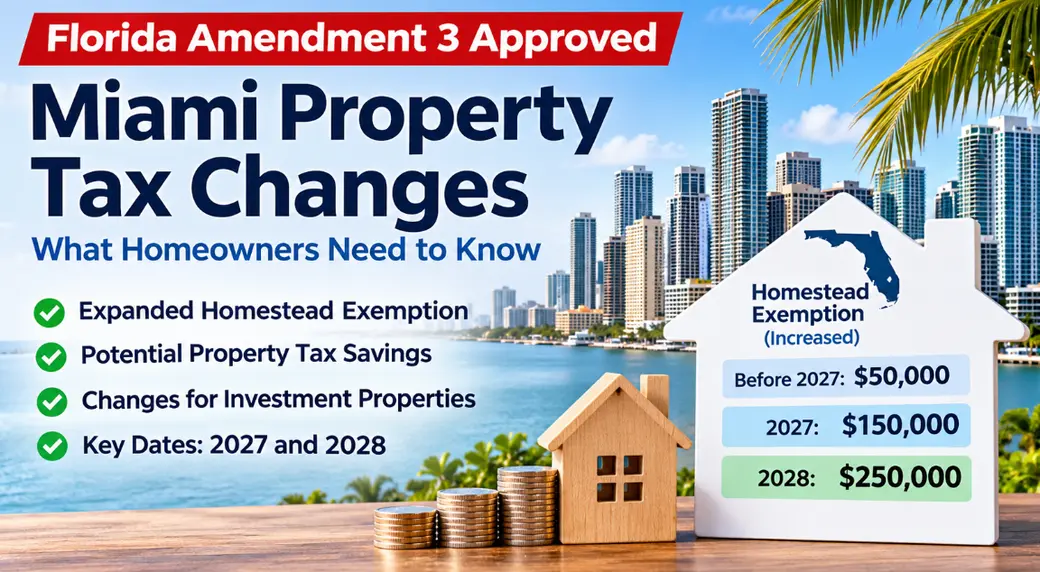
Florida Amendment 3 Approved: How Much Will Miami Homeowners Save on Property Taxes?
Miami Realty Solution Group | November 6, 2026
Florida voters approved Amendment 3 on November 3, 2026, introducing significant changes to property taxation that could affect homeowners, buyers, and real estate investors throughout Miami-Dade County and South Florida.
The amendment expands the homestead exemption for qualifying primary residences and reduces the annual assessment increase cap for certain non-homestead properties.
For Miami homeowners, the biggest question is simple:
How much money could you save on your annual property taxes?
The answer depends on your property's assessed value, local millage rates, homestead eligibility, and the year the new exemption applies.
What Changes Under Florida Amendment 3?
Amendment 3 increases the homestead exemption applicable to non-school property taxes.
| Tax Year | Non-School Homestead Exemption |
|---|---|
| Before 2027 | $50,000 |
| 2027 | $150,000 |
| 2028 | $250,000 |
| 2029 onward | Inflation-adjusted |
The expanded exemption applies to qualifying primary residences.
School property taxes are not eliminated, and homeowners will continue paying applicable school taxes and other assessments.
For eligible homeowners with sufficiently high assessed values, the expanded exemption could substantially reduce annual property taxes.
How Much Could Miami Homeowners Save?
Property tax savings depend primarily on the amount of additional exemption available and the property's non-school millage rate.
A mill represents $1 in property taxes for every $1,000 of taxable property value.
For illustration, consider a qualifying homeowner with a sufficiently high assessed value and a non-school millage rate of 12 mills.
Estimated Annual Property Tax Savings
| Tax Year | Additional Exemption | Estimated Annual Savings |
|---|---|---|
| 2027 | $100,000 | $1,200 |
| 2028 | $200,000 | $2,400 |
Under these assumptions, the homeowner could save approximately $100 per month in 2027 and $200 per month in 2028, compared with the previous exemption structure.
These figures are illustrative, not guaranteed. Actual savings depend on the property's assessed value, applicable exemptions, local millage rates, and final tax calculations.
Why Your Home's Assessed Value Matters More Than Its Market Value
One of the most common mistakes homeowners make when estimating property taxes is using their home's market value instead of its assessed value.
These numbers can be very different.
Market value represents what a property might sell for in the current real estate market.
Assessed value is the value established by the county property appraiser for property tax purposes.
Taxable value is the assessed value after applicable exemptions and adjustments.
Florida's Save Our Homes assessment limitation can also create substantial differences between market and assessed values for long-term homeowners.
For example, a Miami Beach home worth $1.5 million might have a significantly lower assessed value because the owner has maintained homestead eligibility for many years.
The expanded exemption applies to the relevant assessed value when determining taxable value, not directly to the property's estimated selling price.
Homeowners can review their property assessments through the Miami-Dade County Property Appraiser.
Who Qualifies for the Increased Homestead Exemption?
The expanded exemption is intended for qualifying primary residences.
Under Amendment 3, eligible Florida permanent residents who meet the applicable residency and homestead requirements can benefit from the increased exemption beginning in 2027.
Homeowners establishing Florida residency after December 31, 2026, may face different eligibility timing, including a transition period before qualifying for the expanded benefit.
This distinction is particularly important for people relocating to Miami from New York, California, New Jersey, or other states.
Buying a home in Florida does not automatically mean you qualify for every available homestead exemption.
Eligibility depends on residency, ownership, application requirements, and applicable law.
Will Miami Homeowners Still Pay School Property Taxes?
Yes.
Amendment 3 expands the exemption for non-school property taxes. It does not eliminate school district property taxes.
Homeowners may also continue paying non-ad valorem assessments, which can include certain municipal services, solid waste charges, and special assessments.
Consequently, even homeowners whose non-school taxable value is reduced to zero may still receive a property tax bill.
What Happens to Rental Properties and Second Homes?
Amendment 3 also introduces an important change for qualifying non-homestead properties.
Beginning in 2027, the annual assessment increase cap for certain non-homestead properties is reduced from 10% to 5%.
This provision can affect:
-
Investment properties and rental homes.
-
Second homes and vacation properties.
-
Certain non-homesteaded condominiums.
-
Other qualifying non-homestead real estate.
The lower cap may help moderate increases in assessed property values when real estate prices rise rapidly.
However, the cap applies to assessed value increases, not directly to the amount of property taxes owed.
Changes in millage rates, reassessments, ownership, and other factors can still affect annual property tax bills.
For Miami real estate investors, this change could become an important consideration when evaluating long-term ownership costs.
What Does Amendment 3 Mean for Miami's Real Estate Market?
Property taxes represent a significant component of homeownership costs throughout South Florida.
The expanded exemption could influence several areas of the Miami real estate market.
1. Lower Ownership Costs for Qualifying Homeowners
Eligible homeowners could experience lower annual property taxes, improving household cash flow.
For some families, the savings could help offset increases in insurance, maintenance, and other ownership expenses.
2. Greater Appeal for Long-Term Homeownership
Lower property taxes may encourage qualifying homeowners to remain in their properties longer.
This could affect the availability of resale inventory in established residential neighborhoods.
3. Important Considerations for Relocating Buyers
Miami continues to attract buyers relocating from other states.
However, new Florida residents should carefully review homestead eligibility rules rather than assuming they will immediately receive the same tax benefits as established residents.
4. Potential Benefits for Real Estate Investors
A lower non-homestead assessment increase cap could provide additional predictability when evaluating long-term rental property expenses.
Investors should still calculate property taxes based on their anticipated ownership structure and potential reassessment.
5. Potential Changes to Local Government Budgets
Expanded homestead exemptions reduce the taxable property value available to certain local governments.
Counties, municipalities, and special districts may need to evaluate budgets, services, or future millage rates.
Therefore, the actual long-term savings will depend partly on how local governments respond.
What About Miami Condo Owners?
For condominium owners in Brickell, Downtown Miami, Edgewater, Miami Beach, Sunny Isles Beach, Aventura, and other South Florida communities, property taxes are only one part of the cost of ownership.
Condo owners should evaluate:
-
Property taxes and homestead eligibility.
-
Monthly condominium association fees.
-
Building insurance costs.
-
Reserve funding requirements.
-
Special assessments.
-
Maintenance and operating expenses.
An expanded homestead exemption may lower property taxes for eligible condo owners, but it does not directly reduce association fees, building assessments, or insurance premiums.
For buyers comparing Miami condominiums, understanding the complete monthly ownership cost remains essential.
When Will the Property Tax Changes Take Effect?
The amendment establishes the following timeline:
November 3, 2026: Florida voters approved Amendment 3.
January 1, 2027: The constitutional amendment takes effect, introducing the expanded $150,000 non-school homestead exemption for eligible properties.
2027 Property Tax Bills: Eligible homeowners are expected to see the initial changes reflected in their annual property tax calculations.
January 1, 2028: The non-school exemption increases to $250,000 for eligible homeowners.
2029 and Beyond: Inflation adjustments apply under the amendment's provisions.
Homeowners should monitor information from their county property appraiser and tax collector as implementation details become available.
Frequently Asked Questions About Florida Amendment 3
How much will Florida homeowners save under Amendment 3?
Savings depend on assessed value and non-school millage rates. For example, at 12 mills, a qualifying homeowner who can use the full additional exemption could save approximately $1,200 annually in 2027 and $2,400 annually in 2028, assuming unchanged rates and other conditions.
Does Amendment 3 eliminate property taxes in Florida?
No. The amendment expands certain homestead exemptions but does not eliminate all property taxes. School taxes and other applicable assessments remain.
Does Amendment 3 apply to Miami condos?
Yes, qualifying condominium units used as primary residences may benefit from the expanded homestead exemption, subject to eligibility requirements.
Do rental property owners benefit from Amendment 3?
Certain non-homestead properties may benefit from the reduction in the annual assessment increase cap from 10% to 5%. This does not guarantee a reduction in the actual tax bill.
Will new Florida residents qualify immediately?
Not necessarily. New residents establishing eligibility after December 31, 2026, may be subject to different qualification timing under the amendment.
Will property taxes automatically decrease in 2027?
Not for everyone. Actual property taxes depend on assessed values, eligibility, exemptions, millage rates, and other applicable assessments.
The Bottom Line: What Miami Homeowners Should Know
Florida Amendment 3 represents a significant change to the state's property tax structure.
For qualifying homeowners, the expanded homestead exemption could generate meaningful annual savings beginning in 2027, with additional benefits scheduled for 2028.
For real estate investors, the lower assessment increase cap may provide additional protection against rapidly rising assessed values.
However, every property is different.
Before buying, selling, or estimating future property taxes, review the property's assessed value, homestead eligibility, and applicable millage rates.
Understanding these details is especially important in Miami-Dade County, where property values, tax rates, and ownership costs vary considerably between municipalities.
Buying or Selling Real Estate in Miami?
At Miami Realty Solution Group, we help buyers, sellers, and investors navigate the South Florida real estate market.
Whether you're purchasing a primary residence, relocating to Miami, investing in a condominium, or considering selling your property, understanding the full cost of ownership is an important part of making an informed decision.
Miami Realty Solution Group
Serving Miami and South Florida since 2010.
Website: MiamiRealtySolution.com
Phone: 786-361-7289
Disclaimer: This article is provided for general informational purposes and does not constitute legal or tax advice. Property tax calculations and eligibility requirements should be verified with the appropriate county property appraiser, tax collector, or qualified tax professional.
Categories
Recent Posts









GET MORE INFORMATION