Why Miami Real Estate Still Has Runway Compared to Global Cities
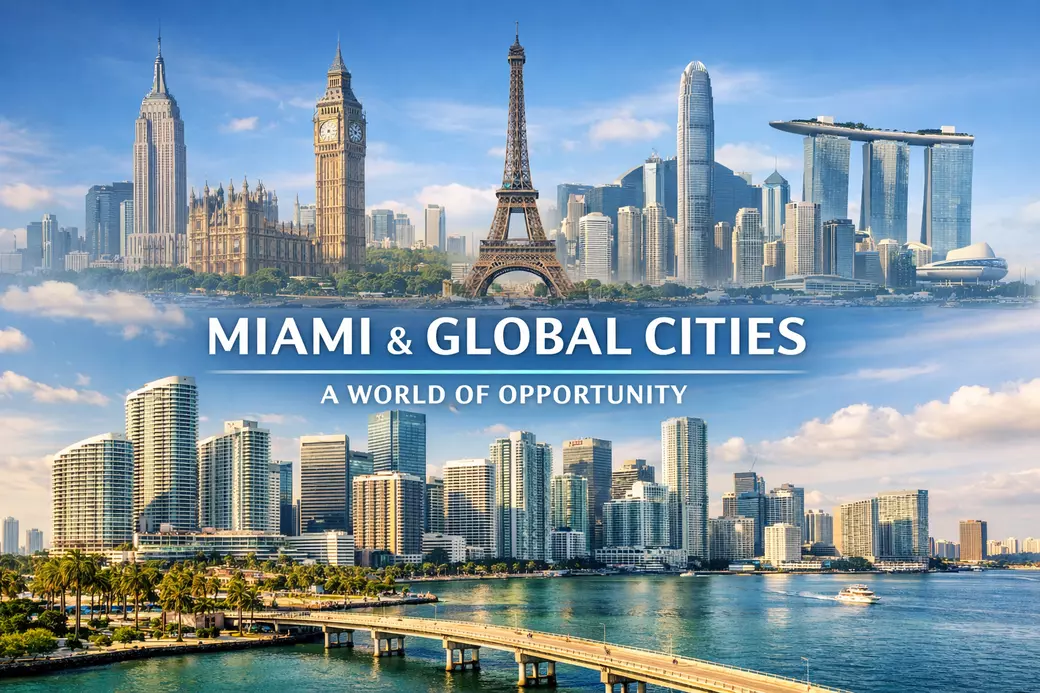
Why Miami Real Estate Still Has Runway Compared to Global Cities
Miami has already become a major global city by population, connectivity, and capital inflow — but its real estate market has not fully repriced to match that role.
That disconnect is not hype. It’s structural — and it explains why Miami still has meaningful runway compared to established global capitals.
This isn’t about calling Miami “cheap.”
It’s about recognizing that Miami is still early in its global re-positioning cycle.
Population vs. Pricing: The Structural Mismatch
The Miami–Fort Lauderdale–West Palm Beach metro area has a population of approximately 6.3 million, placing it firmly among the largest metropolitan regions in the United States.
Yet when compared to established global cities, Miami’s prime condo pricing remains materially lower, particularly in its urban core.
Miami still trails cities such as:
• New York (metro region)
• London (metro / functional region)
• Paris (metro region)
• Hong Kong
• Singapore
• Prime Toronto
• Prime waterfront Dubai
Despite this, Miami already offers many global-city fundamentals:
• A major international airport
• Deep foreign buyer participation
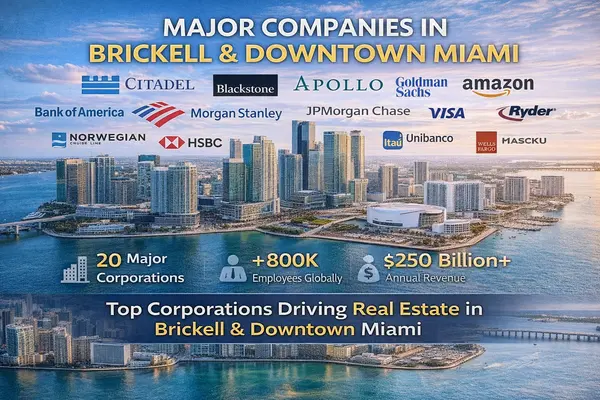
• Financial and corporate inflows
• Lifestyle and tax advantages
• Growing institutional interest
This is not a pricing anomaly — it’s a positioning lag.
Miami vs Global Cities: Structural Comparison
| City | Approx. Metro / City Population | Urban Density Maturity | Prime Condo Pricing Status | Capital Positioning |
|---|---|---|---|---|
| Miami | ~6.3M (metro) | Low–moderate, expanding | Not fully repriced | Emerging global city |
| New York | ~19–20M (metro) | Fully built | Fully priced | Fully institutionalized |
| London | ~14–15M (metro) | Fully built | Fully priced | Fully institutionalized |
| Paris | ~12M (metro region) | Fully built | Fully priced | Fully institutionalized |
| Hong Kong | ~7.5M (city) | Extremely dense | Fully priced | Fully institutionalized |
| Singapore | ~6M (city-state) | Extremely dense | Fully priced | Fully institutionalized |
| Toronto (Prime) | ~6.7M (metro) | Mature | Fully priced | Fully institutionalized |
| Dubai (Prime) | ~3.5–3.7M (city) | Rapidly densifying | Globally priced | Fully repositioned |
Density Gap = Long-Term Upside
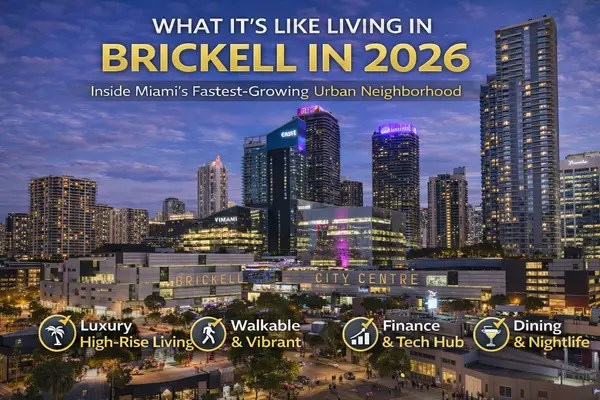
Even in Brickell and Downtown, Miami’s most vertical districts, density remains far below comparable global financial centers such as Manhattan, Canary Wharf, La Défense, or Singapore’s CBD.
This matters because:
• Most global cities are already built out
• New supply is limited and incremental
• Growth is largely priced in
Miami is different.
Zoning changes, transit investment, and vertical development are actively increasing density, not resisting it.
That creates room for:
• New development
• Capital deployment
• Gradual price re-alignment
Why Global Capital Is Still Arriving — Not Finished
Miami’s evolution accelerated recently, not decades ago.
Historically, Miami was viewed as:
• Seasonal
• Lifestyle-driven
• Retirement-oriented
The shift toward:
• Finance
• Hedge funds
• Family offices
• Tech and private capital
is new, not mature.
Real estate markets reprice after capital relocates — not before.
By that measure, Miami appears mid-cycle, not late-cycle.
Infrastructure Is Catching Up to Growth
What separates durable growth from hype is infrastructure — and Miami is now delivering it.
Key drivers include:
• Brightline rail expansion
• PortMiami growth
• Miami International Airport expansion
• New zoning allowances
• Major branded developments (Faena, St. Regis, Waldorf Astoria, etc.)
These are long-term, capital-intensive commitments that reshape cities.
What This Means for Buyers and Investors
Miami’s opportunity is not about predicting short-term appreciation.
It’s about understanding where the city sits in its global evolution.
Miami today is:
• An early global city
• Under-institutionalized relative to peers
• Under-dense compared to true capitals
• Still repricing relative to its economic role
That’s a framework sophisticated investors respect.
Bottom Line
Miami does not need to be labeled “cheap” to be compelling.
It simply needs to be understood in context.
As population, capital, infrastructure, and density continue to align, Miami real estate — particularly in Brickell, Downtown, and Edgewater — still has meaningful runway compared to fully priced global cities.
📍 Looking for your next Miami property?
Contact Miami Realty Solution Group today at 📞 786-361-7289
or visit MiamiRealtySolution.com
to explore the latest deals in Brickell, Downtown, Edgewater, Miami Beach, Surfside, and beyond.
Categories
Recent Posts


GET MORE INFORMATION